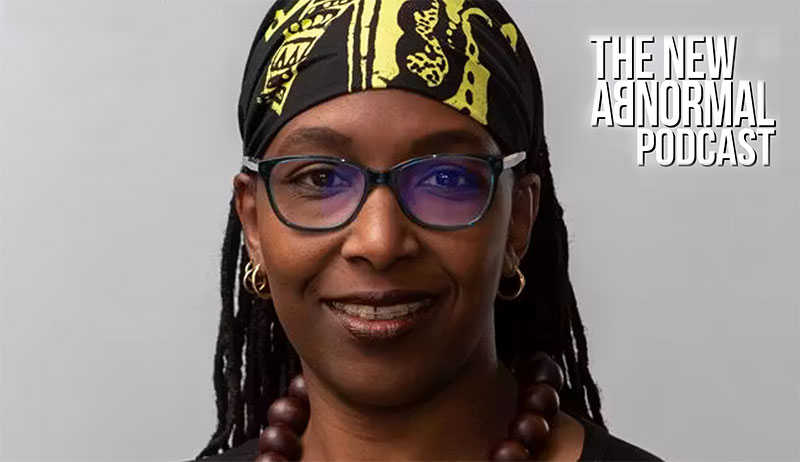
In what I hope you’ll agree is a fascinating conversation, she discussed rethinking futures, activism, and development through more pluralistic and imaginative approaches. Drawing on her interdisciplinary background across technology, urban studies, and foresight, Geci explained her shift towards post-activism, arguing that conventional responses to crisis often reproduce the very systems they seek to change. Rather than prioritising action alone, she advocates deeper understanding, experimentation, and humility in the face of complexity.
She also illuminated the emerging African Foresight Network, which seeks to cultivate futures thinking rooted in African and Global South perspectives, indigenous knowledge systems, and diverse conceptions of time. Geci discussed challenging linear, Western models of futures thinking and encouraging more culturally grounded approaches – she also critiques the dominance of reductionist foresight methods (e.g. the 2×2 scenario matrix) calling for richer, more inclusive epistemologies and methodologies.
Turning to urban futures, Geci outlined her work on a decolonial critique of urban studies, arguing that African cities are often constrained by limiting narratives. She advocates moving beyond these imaginaries through experimentation and new narratives. The discussion concluded with her work on AI, development models, and an “Alt Lab” for social experimentation. Finally, she explained how creating better futures depends on strengthening imagination, inclusion, and institutional transformation…